
Filling in a day
Available onBuilder
The diary opens on today. The day strip across the top moves between days, and Go to date jumps to any day directly.
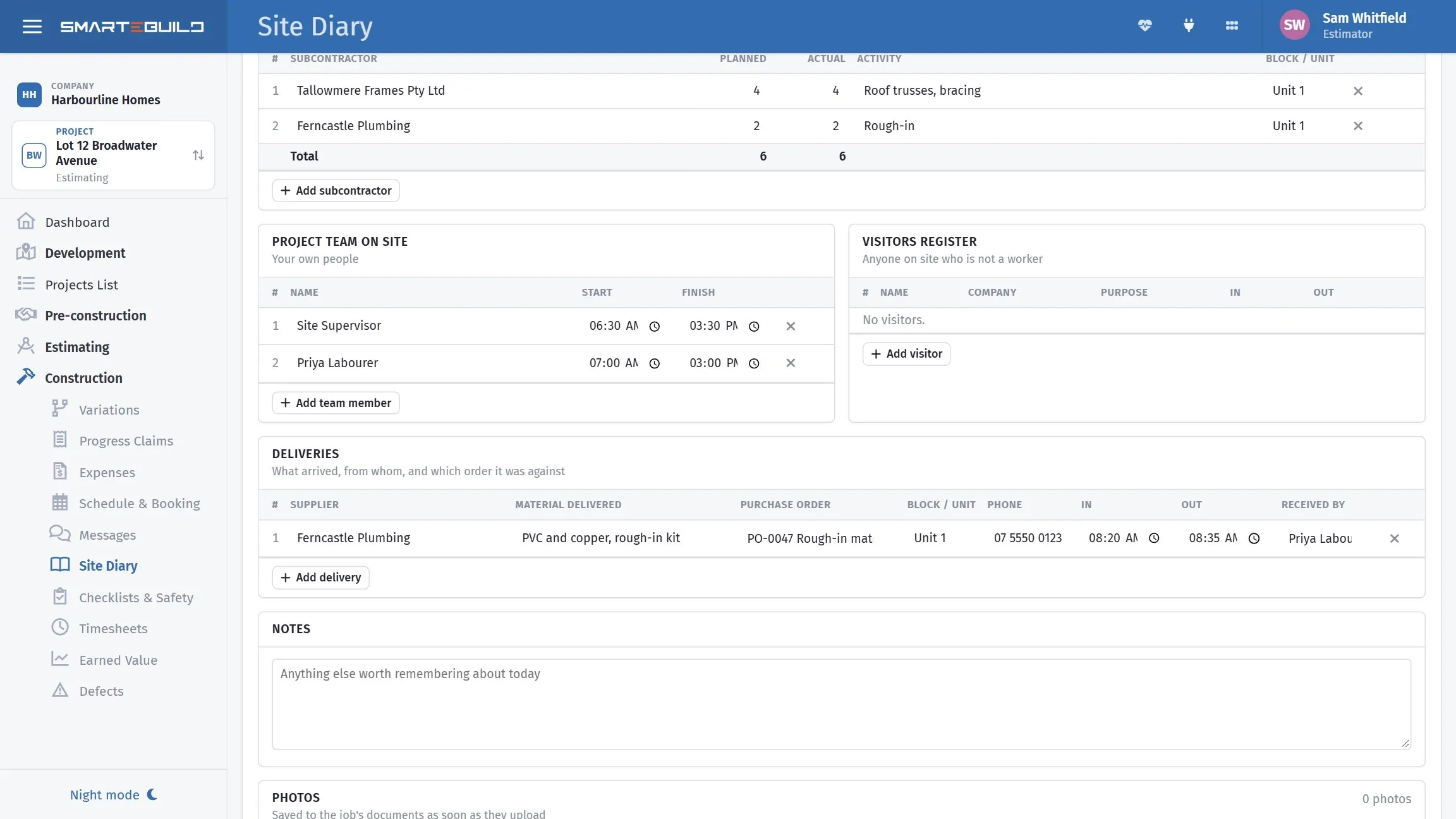
Who was there, what arrived, and what held the job up.
Who was on site
Section titled “Who was on site”Three separate registers, because they answer different questions:
Project team on site — your own people. This is what a labour cost query is checked against.
Subcontractors on site — which trades were there, and how many. The record that matters when a subcontractor claims they were on site for six days and you have four.
Visitors register — the client, a building surveyor, an engineer, a delivery driver who needed signing in. On a job with any safety obligation this is not optional, and it is much easier kept daily than reconstructed.
Fill from the site register
Section titled “Fill from the site register”If the job uses the site register, Fill from site register, above the list of subcontractors, says how many people signed in that day. Press it and the day’s sign-ins are merged into the form: each company with its head count and trade, and the visitors. Hover over the button to see the names first.
It adds to what is there rather than replacing it. A company already on the list has its actual head count updated, and nothing is kept until you press Save.
Deliveries
Section titled “Deliveries”What arrived, and from whom.
Record the docket number and anything wrong with the delivery — short counts, damage, wrong product. That note is what supports a credit claim three weeks later when the supplier’s statement does not match what you received.
Photos
Section titled “Photos”Photographs with captions, and the part of the diary that pays for itself.
Photograph anything you might need to prove: the excavation before the pour, the rock that stopped the digger, the frame the inspector passed, the state of the neighbouring fence before you started.
Everything that does not fit elsewhere. Write for someone reading it in a year who was not there — because that is exactly who reads a diary.
| Weak | Better |
|---|---|
Rain |
Rain from 11am, 4 hours lost, pour postponed to Thursday |
Delivery |
Frame delivery, Surf Coast Steel, docket 88421, 2 bundles short — chased |
Client visit |
Client on site 2pm, confirmed alfresco extension, variation to follow |
Printing a day
Section titled “Printing a day”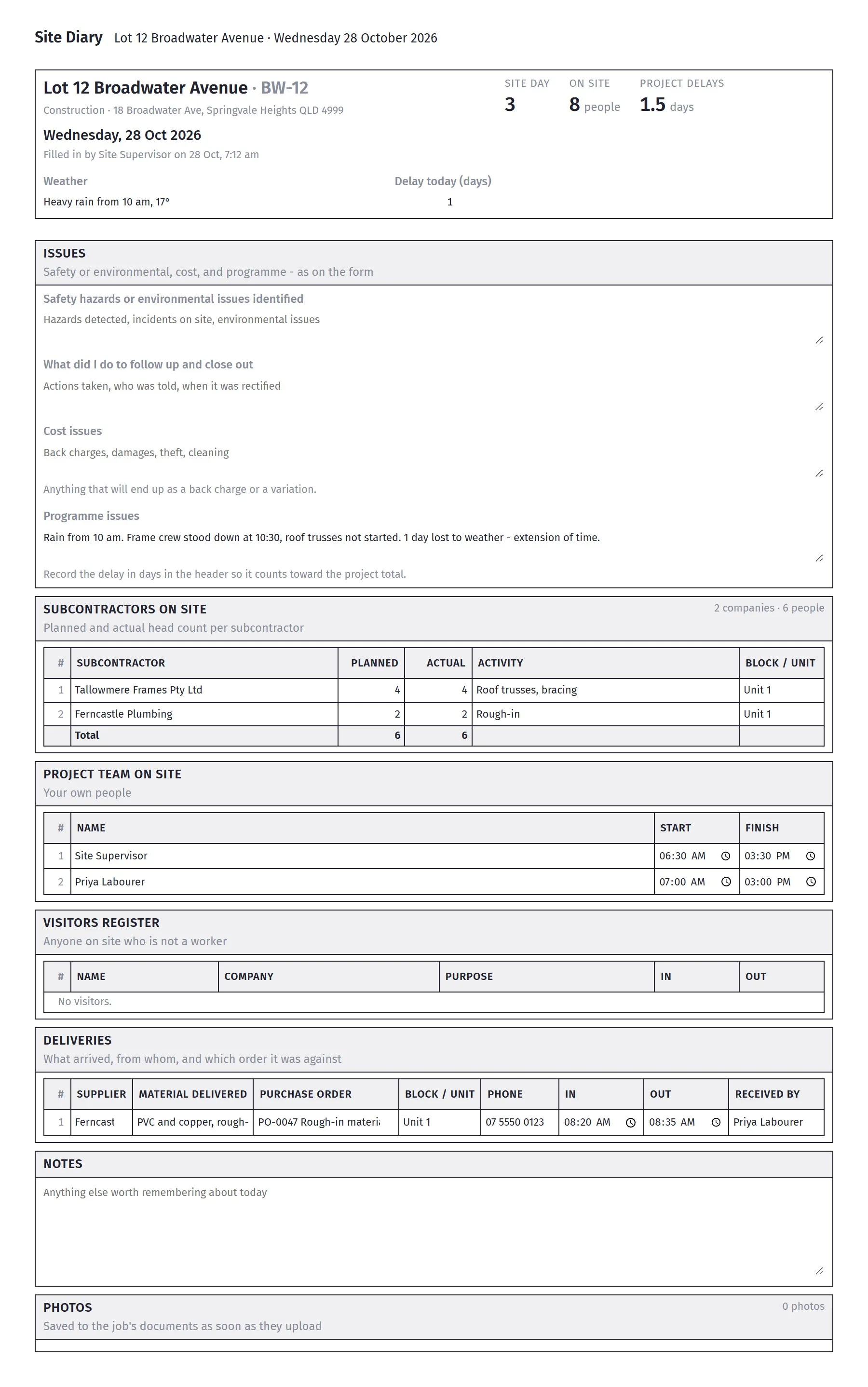
This is what you attach to an extension of time claim.
Print this day as the diary form produces the day as a formal document.
That is what you attach to an extension of time claim, hand to a superintendent, or keep on file. A printed run of days around a disputed period is a much stronger submission than an assertion about what happened.
A PDF of a run of days
Section titled “A PDF of a run of days”PDF, next to Print, makes the diary as a PDF instead of on paper. Choose the From and To dates and it makes one page for each day that has an entry - a quiet day with nothing recorded is left out. Include photos puts each day’s photos in; leave them out for a small file to email.
- Open PDF opens it to read, print or send.
- Save to Documents files it in the job’s Documents, in the Site Diary folder, so it is in the register with everything else - and ready for the extension of time claim it backs up.
Deleting a day
Section titled “Deleting a day”Delete day removes an entry. Use it for a day created by mistake, not to tidy up a day you would rather not have recorded.
A diary with gaps around the difficult weeks is worse than no diary — it invites exactly the question you did not want asked.
Doing it on the phone
Section titled “Doing it on the phone”Almost all of this is better done on site as the day happens. The app has the same day view, plus dictation for the notes. See The site diary on site.
A workable habit
Section titled “A workable habit”- Morning — who is on site, in both registers.
- As things happen — deliveries, visitors, anything that goes wrong.
- End of day — the delay figure, and the photos captioned.
Five minutes across the day. The alternative is an hour on Friday producing something that will not stand up.