
Sales register
Available onDeveloper
One line per lot, from “available” through to the money arriving. It is the other half of the feasibility: the feasibility says what you expect to sell them for, this says what you did.
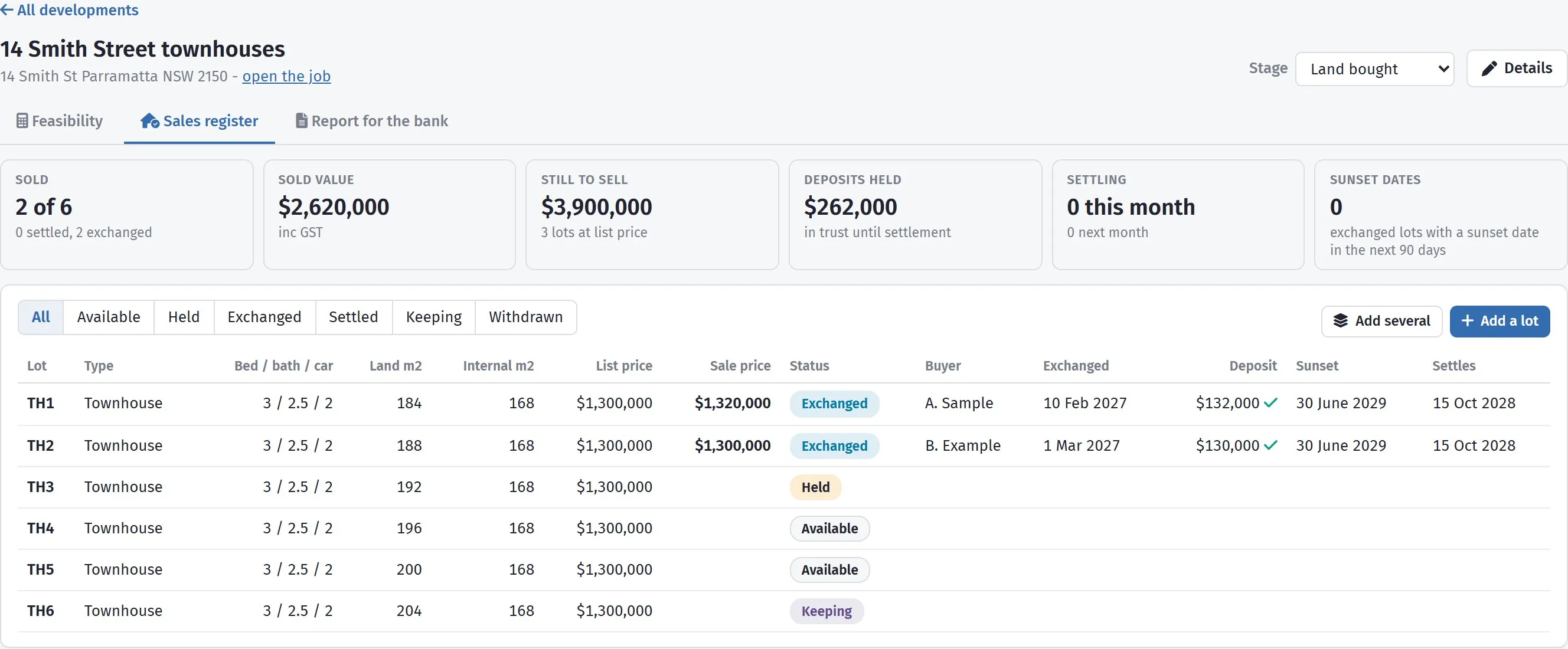
Sold of total, what is still to sell, and every lot with its status.
The statuses
Section titled “The statuses”| Status | What it means |
|---|---|
| Available | On the market, nothing agreed |
| Held | Someone has it on hold. Not binding |
| Exchanged | Contracts exchanged, deposit paid. This is the one that counts |
| Settled | Money received, title transferred |
| Withdrawn | Taken off the market |
| Keeping | Not for sale. You are holding it — to rent, or to live in |
Exchanged is the status that matters to a lender. Held is a conversation; exchanged is a contract, and it is what pre-sale cover is counted from.
Keeping is deliberately separate. A lot you keep is not a lost sale and should not drag the sold figure down — but it is also not revenue, so the feasibility stops expecting money for it.
Adding lots
Section titled “Adding lots”Add several is the one to use at the start. Six townhouses numbered TH1 to TH6, all the same type, all the same price, in one go. Edit the ones that differ afterwards — the corner one that carries a premium, the one with the smaller yard.
Each lot holds its number, type (townhouse, unit, lot, house), bedrooms, bathrooms, car spaces, land area and internal area, then the money and the dates.
Prices
Section titled “Prices”List price is what you are asking. Sale price is what you got.
Both are inc GST, labelled as such — the same rule as a contract price everywhere else in SmarteBuild. The GST treatment you chose on the feasibility is what turns that into a net figure.
The buyer
Section titled “The buyer”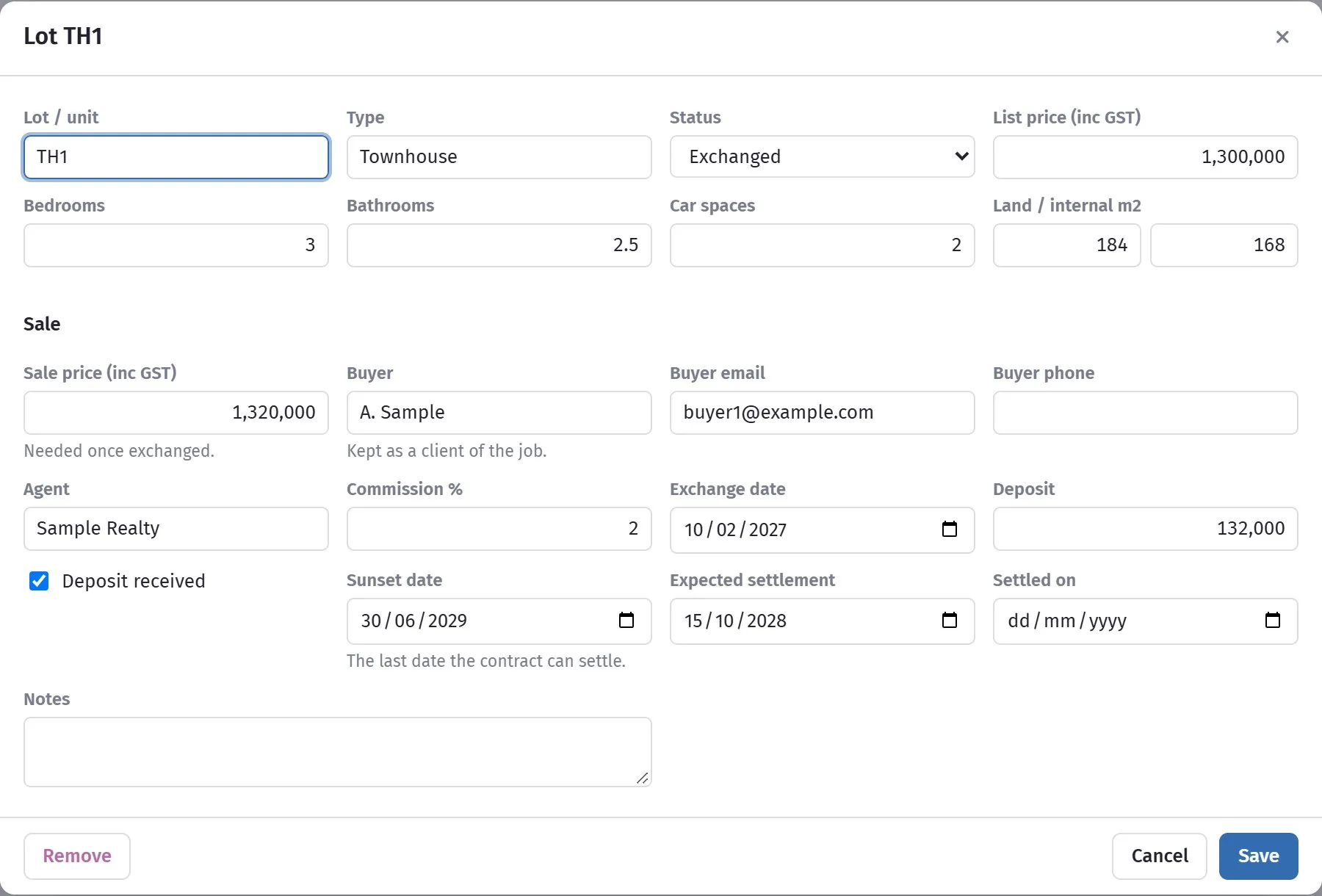
Price, buyer, exchange, deposit, sunset and settlement, on one window.
Name, email, phone and their solicitor, plus the selling agent and the commission.
The buyer is saved as a client of the job. That is deliberate: they are the person who will be sending you defects after handover, and this way they are already on the job rather than being typed in a second time. It also means a client portal can be opened for them later.
The dates that matter
Section titled “The dates that matter”| Date | Why it matters |
|---|---|
| Exchange date | When the contract became binding, and when pre-sale cover starts counting |
| Deposit | Amount, and whether it has been received |
| Sunset date | The date the buyer can walk away if the building is not finished |
| Expected settlement | Drives the cash flow until there is a real one |
| Actual settlement | Replaces the expectation once the money is in |
What it feeds
Section titled “What it feeds”Nothing here has to be copied anywhere. The register drives three things:
- The feasibility’s sales lines — real prices replace the expected ones
- The cash flow — real settlement dates replace the expected months
- Pre-sale cover — exchanged sales against the loan, which is the number the bank watches before releasing construction funding
Along the top: sold X of Y, sales so far, still to sell, and settlements expected this month and next. The last of those is the one to check on a Monday — a settlement you were counting on that has not happened is a hole in the month.