
Report for the bank
Available onDeveloper
Every lender asks for the same thing in roughly the same order. This is that document, built from the feasibility you already have, so the numbers in it cannot drift from the numbers on your screen.
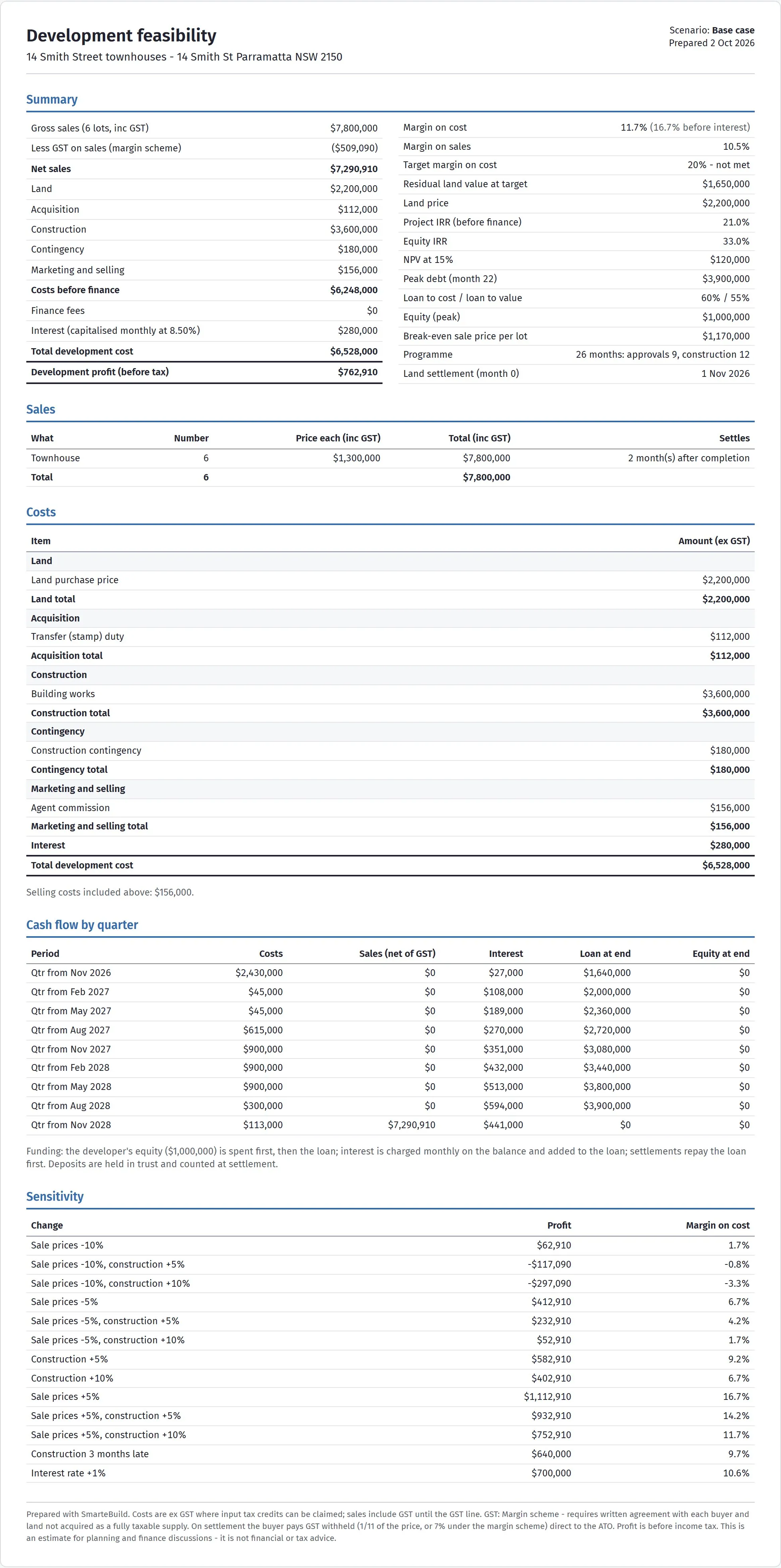
The summary in lender order, then the schedules behind it.
What is in it
Section titled “What is in it”| Section | What it holds |
|---|---|
| Summary | The project in lender order — total development cost, total sales, profit, margin on cost, peak loan, loan to value, pre-sale cover |
| Sales schedule | Every lot, its price, status and settlement date |
| Cost schedule | Every cost line, what it is and when it is paid |
| Quarterly cash flow | Money out, money in and the loan balance, by quarter |
| Sensitivity | The what-if grid: sales down, costs up, running late, rates up |
| Notes | GST treatment, withholding and tax |
The sensitivity table is worth putting in front of a lender rather than waiting to be asked for it. It says you have already thought about what happens when the market moves.
Download as Excel
Section titled “Download as Excel”Download as Excel, beside the print button, gives the same material as a workbook — the summary, the cost and sales schedules, the month-by-month cash flow, the what-if grid and, for anyone allowed to see it, the sales register. The figures are numbers rather than text, so a lender’s analyst can work with them instead of retyping.
See Taking it to Excel for what is on each sheet.
Printing it
Section titled “Printing it”Print uses your browser, so it goes to a printer or to a PDF — on Windows choose Save as PDF as the destination, or Microsoft Print to PDF.
Save it with the date in the file name. A bank will come back weeks later referring to “the feasibility you sent”, and you want to know which version that was.
Before you send it
Section titled “Before you send it”Worth two minutes:
- Is the right scenario chosen? The report follows the chosen scenario, not whichever one you were last looking at.
- Is the build cost current? If it is linked to an estimate, it moves when the estimate moves — which is right, but check it is the estimate you mean.
- Does the sales schedule match reality? Lots still marked Available that have exchanged make your pre-sale cover look worse than it is.
- Is the GST treatment the one your accountant agreed? It changes the profit materially, and it is the first thing a lender’s analyst will test.